
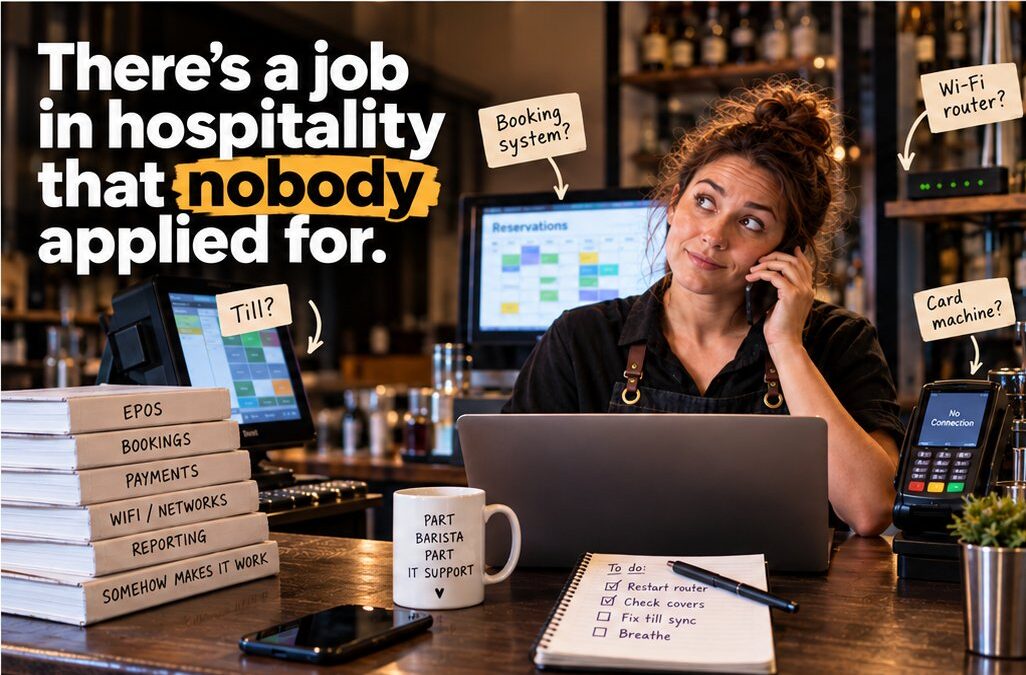
There’s a job in hospitality that doesn’t appear on any rota. It has no title and no pay grade, but almost every venue has someone doing it.
They’re the person who knows that the booking system and the till don’t quite agree, so the covers figure needs checking by hand every Monday. They know which supplier portal to log into when the stock numbers look wrong. They know that if the card machine drops out, you restart the router in the back office, not the one behind the bar. They learned all of this by accident, and none of it is what they were hired for.
In April 2026, the property management provider RMS and the pricing tool RoomPriceGenie published research that gave this person a name: the hospitality engineer. Their findings suggest that 42% of hospitality professionals spend one to three hours a week resolving technology and data problems, with one in five spending four hours or more. Around 83% said their technology causes operational stress. A quarter said nobody in the business is responsible for whether their systems talk to each other at all.
A word on that research, because it matters
We’re not going to present those numbers as settled fact. They come from two technology vendors who sell the solution to the problem they’ve measured, the published methodology doesn’t tell us the sample size or who was surveyed, and the respondent base appears to lean towards holiday parks and larger accommodation providers rather than the independent pubs, restaurants and small hotels that make up most of the sector.
So, treat the percentages as a signal rather than a verdict.
What we can tell you with much more confidence is what we see across the venues we support through our hospitality IT support, because we’re in these back offices every week. And the research is pointing at something real.
What it actually looks like on the ground
People in hospitality are frustrated with their technology, and the frustration is rarely about a single broken thing. It’s cumulative.
It’s a general manager whose actual expertise is running a floor and looking after a team, spending their Tuesday morning reconciling two systems that should reconcile themselves. It’s a duty manager who can’t get hold of anyone when the Wi-Fi goes down on a Saturday night, because the support contract covers weekdays. It’s a kitchen team typing the same delivery note into two places because nobody ever connected the stock system to the accounts package.
A good example is the Ramada Encore Newcastle Gateshead, where the guest Wi-Fi had become difficult for both guests and staff to manage. To ease the burden, AMiTEK replaced the ageing infrastructure across the hotel and introduced a secure Guest Access Portal, eliminating the need for shared passwords.
The result was better coverage, reliability, and performance, along with fewer connectivity queries reaching the front desk. Importantly, the Wi-Fi now works without staff having to stop what they’re doing and step in.
Three patterns come up again and again:
Systems bought one at a time, never as a set.
A venue buys an EPOS because the old till died. Two years later it adds a booking platform. Then a rota app, because the paper rota was chaos. Each decision was sensible on its own day.
Nobody was ever asked to make them work together, so the joins are held together by someone’s memory and a spreadsheet. This is the single most common thing we’re called in to untangle, and it’s why EPOS and PMS setup is worth getting right at the point of purchase rather than two years later.
Support that doesn’t match trading hours.
Hospitality’s busiest hours are precisely when most IT support is asleep. A problem at 8pm on a Friday isn’t an inconvenience; it’s lost covers and a queue of irritated guests. Outsourced IT support built around when a venue actually trades solves more perceived “system problems” than any software change.
Connectivity treated as a utility rather than infrastructure.
Guest Wi-Fi, card payments, the booking system, and the cloud backup usually share one connection with no fallback. When it wobbles, everything wobbles at once, which is why it feels like the technology has failed when, in fact, one line has. Connectivity done properly is the least visible and highest-value thing most venues could fix this year.
Makeney Hall Hotel is a great example of what this looks like in practice. Previously, key hotel data was hosted on a local server, restricting access to staff on-site or connected through a VPN. Device deployments and employee onboarding were also dependent on access to the hotel’s network.
AMiTEK modernised the environment by migrating the hotel to a fully cloud-managed Microsoft 365 platform, combining Exchange, SharePoint, Teams and Intune into a single, secure ecosystem.
The result was a more agile workforce, simplified IT management, faster onboarding, and secure access to business-critical information from anywhere. For the team, this has meant less time spent firefighting hardware and more time running the hotel.
The stress is a symptom, not the problem
That 83% stress figure, whatever its methodology, is measuring something worth paying attention to. But stress isn’t caused by technology being complicated. It’s caused by nobody owning it.
A venue running four systems with clear ownership and proper integrations runs more smoothly than one running two systems that nobody is responsible for. The number of tools is almost never the issue. The gaps between them are.
If someone in your business has quietly become your hospitality engineer, that’s not a sign they’re resourceful. It’s a sign the role exists and hasn’t been filled properly.
If any of this sounds like your bar, restaurant, or hotel, we’d like to hear about it. Take a look at how our IT support for hospitality businesses works, or give us a call on 0118 324 4100, and we’ll tell you straight whether we can help.